

Guided Biofilm Therapy (GBT) is a structured teeth cleaning protocol that starts by staining the bacterial film on your teeth so it can be seen, then removes it with a fine jet of air, warm water and a very fine powder, and only uses an ultrasonic tip where hard tartar remains. Compared with a traditional scale and polish, it targets the cause of gum disease and decay more precisely, reaches places a rubber cup can't, and most patients find it more comfortable. It is especially useful if you have braces, implants, crowns, veneers, sensitive teeth or gum problems.
Most people think of a dental cleaning as scraping off tartar and polishing the teeth with a gritty paste. That routine helped a lot of patients for decades, but it has one weakness: the dentist or hygienist can't see the thing that actually causes gum disease and cavities.
That thing is biofilm, the soft, sticky layer of bacteria that builds up on teeth every day. It is almost invisible on clean-looking teeth. Guided Biofilm Therapy, usually shortened to GBT, was designed around one simple idea: if you make the biofilm visible first, you can remove all of it, and only it, with less force. Here is how it works, what it feels like, and who benefits most.
Biofilm: the real target of a dental cleaning
Within hours of brushing, bacteria start attaching to your teeth again. They organise themselves into a protective layer called biofilm, sometimes known as plaque. Left alone, it does two things:
- Bacteria in the biofilm produce acids that dissolve enamel and start cavities.
- Biofilm along and under the gumline irritates the gums, causing bleeding, inflammation and, over time, gum disease and bone loss.
When biofilm stays long enough, minerals from saliva harden it into tartar (calculus). Tartar itself is rough and holds even more biofilm, but the biofilm is what does the damage. That is why modern prevention focuses on removing biofilm thoroughly, including in the places brushing misses: between teeth, around brackets, under bridges and around implants.
What is guided biofilm therapy?
Guided Biofilm Therapy is a clinical protocol developed by the Swiss company EMS together with dental schools and clinicians. It combines three technologies in a fixed order:
- A disclosing solution that colours biofilm so both you and the clinician can see it.
- AIRFLOW, a controlled jet of air, warm water and a very fine powder (usually based on erythritol, a gentle sugar alcohol) that lifts biofilm and stains from teeth, gums, restorations and implants.
- PIEZON PS, a slim ultrasonic tip used only where hard tartar remains after the airflow step.
The key word is "guided". Instead of cleaning every surface the same way, the clinician follows the colour and works where the biofilm actually is. You can read the protocol overview on the EMS GBT page, and a clinical introduction in the British Dental Journal.
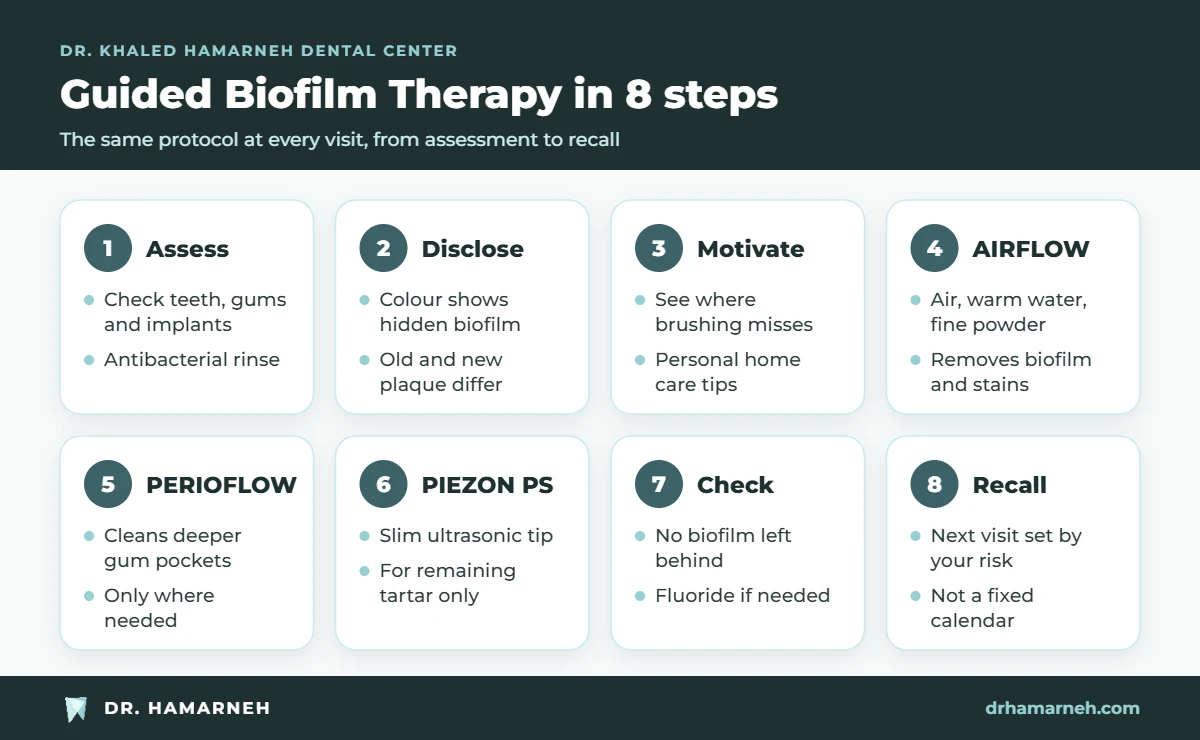
The 8 steps of GBT, explained simply
- Assess and protect. The clinician checks your teeth, gums and any implants, and you rinse with an antibacterial mouthwash to reduce bacteria in the air during treatment.
- Disclose. A disclosing solution is painted on. Fresh biofilm and older, more mature biofilm show up in different colours.
- Motivate. You see exactly where brushing and flossing are missing, and get practical advice for those spots.
- AIRFLOW. Air, warm water and fine powder remove biofilm, stains and young tartar from teeth, gums, tongue, restorations, braces and implants.
- PERIOFLOW. In deeper gum pockets, a thin nozzle cleans below the gumline where needed.
- PIEZON PS. Any remaining hard tartar is removed with a slim ultrasonic tip, gently, because most of the work is already done.
- Check. A final check makes sure no biofilm or tartar remains. Cavities are checked and, if needed, fluoride protection is applied.
- Recall. Your next visit is planned according to your risk, not a fixed calendar.
Notice what is missing: the polishing paste and rubber cup. GBT does not need them, because the airflow step already leaves teeth smooth and clean.
Guided biofilm therapy vs a traditional scale and polish
| Point | Traditional cleaning | Guided biofilm therapy |
|---|---|---|
| Can the biofilm be seen? | Mostly not | Yes, it is stained first |
| Main tool | Scaler, then rubber cup and paste | Airflow first, ultrasonic only where needed |
| Between teeth and around brackets | Hard for a cup to reach | Fine jet reaches these areas |
| Implants, crowns, veneers | Paste can roughen some surfaces | Gentle on restorations and implants when used correctly |
| Comfort | Scraping and vibration | Most patients find it gentler |
| Stains from coffee, tea, smoking | Partly removed | Removed well |
| Home care advice | General | Based on what the colour shows |
Both approaches remove tartar. The difference is precision and comfort: GBT spends less force on clean surfaces and more attention on the areas that actually hold bacteria.
Who benefits most from GBT?
- Patients with braces or aligner attachments. Biofilm collects around brackets and wires, and enamel next to them can decalcify. The fine jet cleans where brushes struggle.
- People with dental implants. Implants can develop gum inflammation just like teeth. GBT was designed to clean implant surfaces gently.
- Crowns, bridges and veneers. Cleaning without abrasive paste helps preserve the glaze and margins of restorations.
- Sensitive teeth and nervous patients. Warm water and less scraping usually mean a calmer visit.
- Gum disease and bleeding gums. Removing biofilm thoroughly, including below the gumline, is the foundation of gum treatment.
- Coffee, tea and smokers' stains. Airflow removes surface stains efficiently, so teeth look brighter afterwards.
If you are planning orthodontic treatment, veneers or dental implants, a thorough cleaning beforehand gives the treatment a healthy starting point.
Book a GBT cleaning in Khalda and see, literally, where your brushing is missing.
What guided biofilm therapy does not do
Being clear about limits helps you set the right expectations:
- It is not whitening. GBT removes surface stains, so teeth often look a shade or two cleaner, but it does not change the natural colour of the tooth. That is a job for whitening.
- It does not replace treatment for advanced gum disease. Deep pockets, bone loss and loose teeth need a full periodontal plan. GBT can be part of that plan, not all of it.
- It does not fix cavities. The check step can find them early, but they need separate treatment.
- Heavy tartar still needs the ultrasonic step. If tartar has built up for years, the first visit may take longer or be split into two.
- It does not replace home care. Biofilm returns within hours. Brushing twice a day and cleaning between teeth daily are what keep the result.
The powder used for GBT is chosen for gentleness, but the airflow step is not suitable for everyone in the same way. People with certain respiratory conditions or allergies should tell us beforehand so the protocol can be adapted.
After your GBT cleaning
- Your teeth will feel very smooth. Many patients say it is the cleanest their mouth has felt.
- Gums that were inflamed may feel slightly tender for a day. This settles quickly.
- If fluoride was applied, avoid eating and drinking for the time the clinician tells you.
- Use the photos or advice from the disclosing step: if colour kept showing between your back teeth, that is where to add floss or interdental brushes.
- Most people do well with a cleaning every six months. Patients with braces, implants or gum disease may need visits every three to four months.
Guided biofilm therapy at our clinic in Khalda
At Dr. Khaled Hamarneh Dental Center in Khalda, we use original EMS equipment and follow the Guided Biofilm Therapy protocol step by step. We start with a check of your teeth, gums and any restorations, show you where biofilm is hiding, clean with airflow first, and only use the ultrasonic tip where tartar needs it. Before you leave, we explain what we found and when your next visit makes sense for you.
If the examination shows gum disease, cavities or other problems, you get a clear written plan for treating them, and you decide what happens next. You can read more about our team or check our guide on choosing the best dentist in Khalda.
Minas Towers, 3rd Floor, Medical City Street, Khalda. Saturday to Thursday, 10:30 am to 7:00 pm.
Questions patients ask us
What is guided biofilm therapy?
Guided biofilm therapy (GBT) is a teeth cleaning protocol that makes bacterial biofilm visible with a disclosing solution, removes it with a jet of air, warm water and fine powder, and uses an ultrasonic tip only where hard tartar remains. It follows the same eight steps at every visit.
Is GBT better than a normal dental cleaning?
GBT is more targeted than a traditional scale and polish because the biofilm is stained and seen before it is removed. It reaches areas a polishing cup can't, is gentle on restorations and implants, and most patients find it more comfortable.
Does guided biofilm therapy hurt?
Most patients find GBT comfortable. It uses warm water and much less scraping than a traditional cleaning. Very inflamed gums or heavy tartar may feel sensitive, and local anaesthetic can be used if needed.
Does GBT whiten teeth?
GBT removes surface stains from coffee, tea and smoking, so teeth often look brighter. It does not change the natural colour of the tooth, which requires professional whitening.
Is GBT safe for braces, implants and veneers?
Yes. GBT was designed to clean around brackets, implants, crowns and veneers gently, without the abrasive paste used in traditional polishing.
How long does a GBT cleaning take?
A typical session takes about 45 minutes to an hour. The first visit can take longer if there is a lot of tartar or if gum pockets need cleaning below the gumline.
How often should I have a GBT cleaning?
Most people benefit from a cleaning every six months. Patients with braces, implants or gum disease may need visits every three to four months. Your dentist sets the interval based on your risk.
Where can I get guided biofilm therapy in Amman?
Dr. Khaled Hamarneh Dental Center in Khalda, Amman, offers teeth cleaning using the original EMS guided biofilm therapy protocol and equipment. Book online, call or WhatsApp 0791818796.