

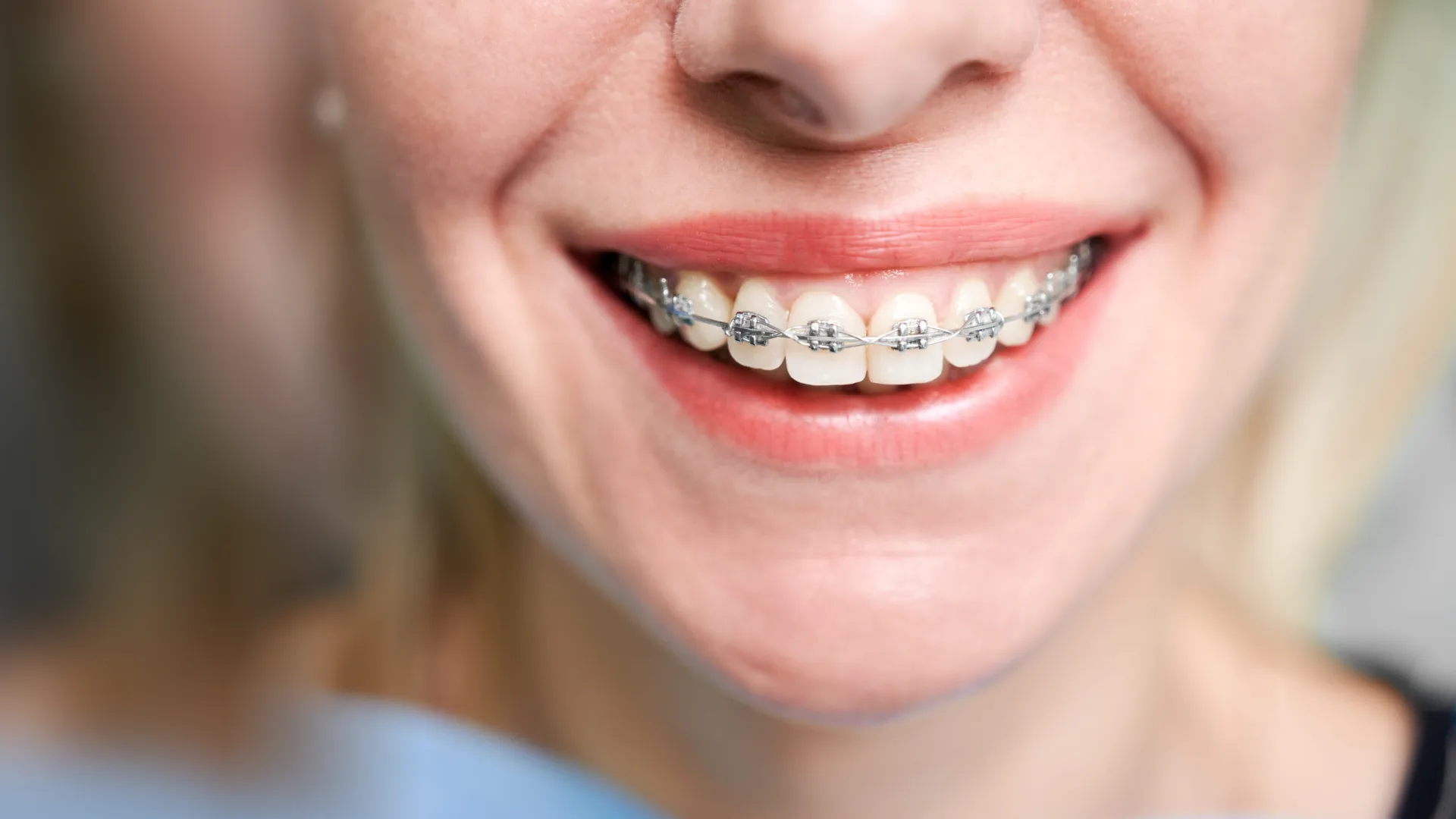
All three types of braces can give you straight teeth and a healthy bite. Clear aligners are almost invisible and removable, but they only work if you wear them 20 to 22 hours a day, and some complex movements are harder with them. Self-ligating braces use a built-in clip instead of elastic ties, so they are cleaner and visits are quicker, although research shows they don't finish treatment faster. Ceramic braces are fixed like metal braces but tooth-coloured, which suits people who want discreet braces without the discipline aligners demand. The right choice depends on your bite, your lifestyle and how much control the movement needs.
Most people who search for types of braces already know they want straighter teeth. What they really want to know is which option is the least visible, the most comfortable and the fastest, and whether paying more for one type actually changes the result.
The honest answer is that the brackets or trays matter less than the plan behind them. A well-diagnosed case with ordinary braces will beat a poorly planned case with the most expensive aligners every time. Still, the differences between clear aligners, self-ligating braces and ceramic braces are real, and they affect your daily life for a year or more. This guide walks through how each one works, where each one shines, and where each one struggles, so you can walk into your consultation with the right questions.
How braces move teeth, whatever type you choose
Teeth are not fixed in solid bone. Each one sits in a socket and is held by a thin ligament that responds to pressure. When a gentle, steady force pushes a tooth, the bone on one side slowly breaks down and new bone forms on the other side. The tooth moves through the bone, a fraction of a millimetre at a time.
That biology is identical for all types of braces. What changes is how the force is delivered:
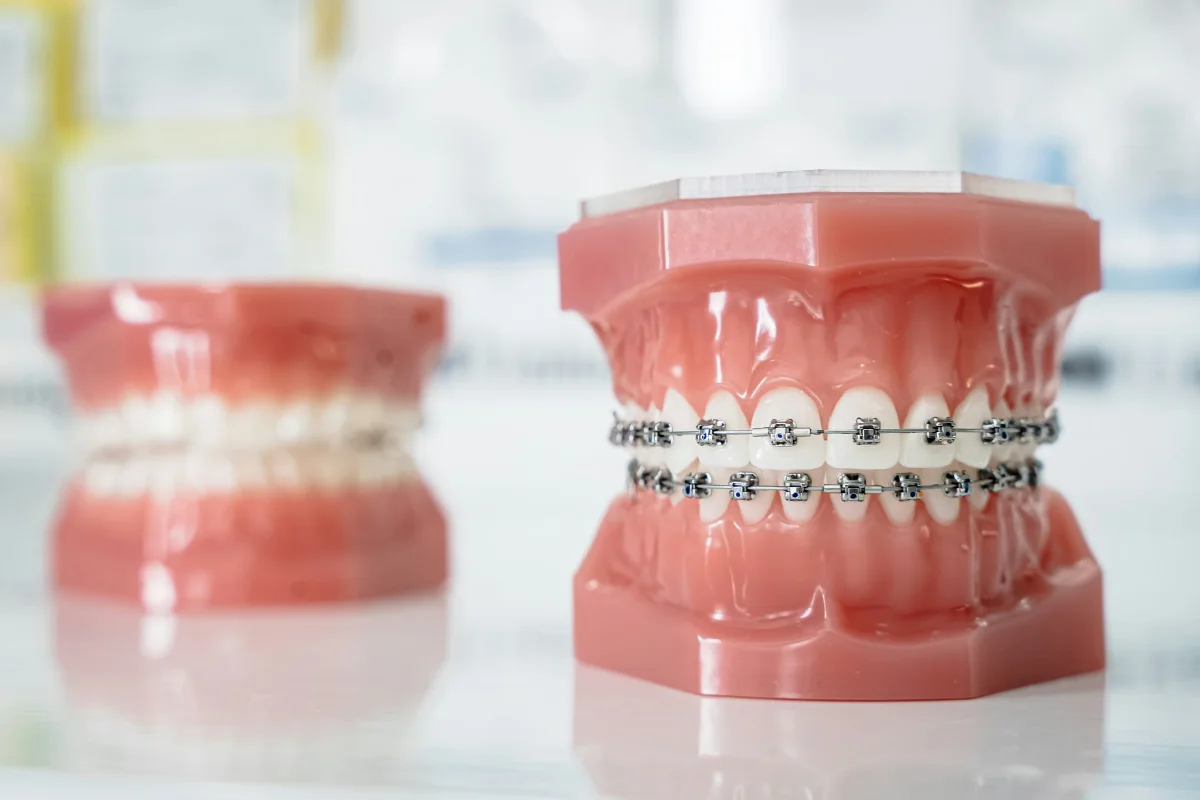
- Fixed braces (metal, ceramic or self-ligating) use small brackets bonded to the teeth and a wire that the orthodontist shapes and changes over time. The wire stores energy and releases it slowly.
- Clear aligners are a series of thin plastic trays. Each tray is made slightly different from the last, and small tooth-coloured bumps called attachments give the plastic something to push against.
Because the bone needs time to remodel, no system can safely rush the process. Any of the types of braces sold with a promise of a dramatic shortcut deserves a second look.
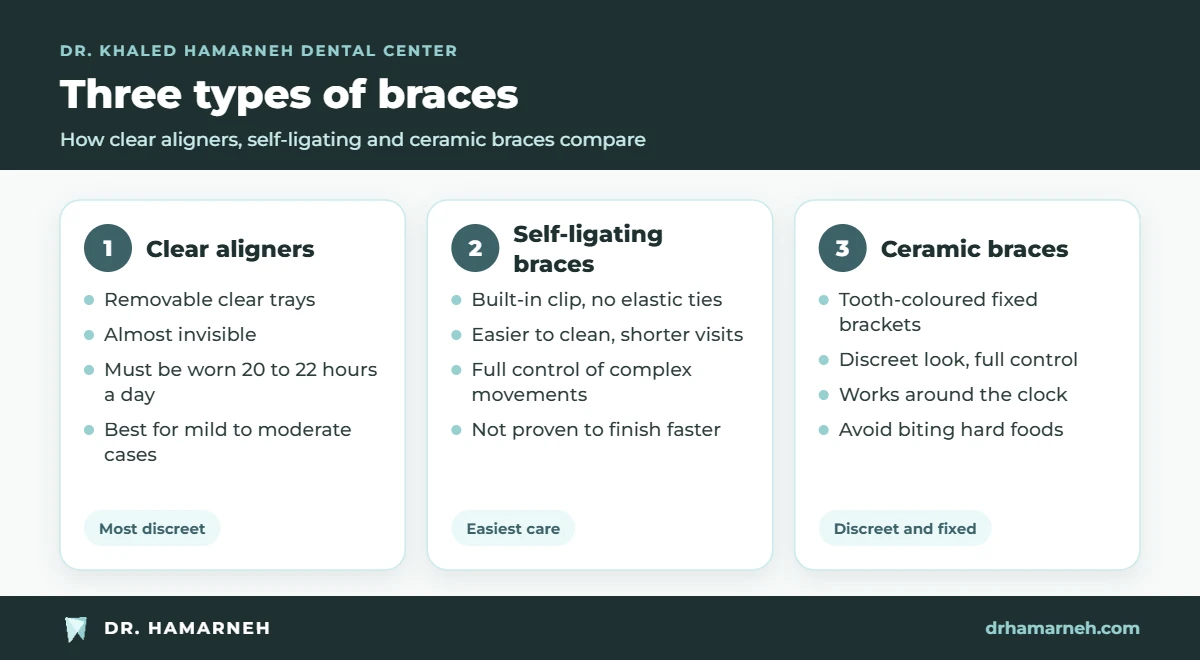
Clear aligners: nearly invisible, but they depend on you
Clear aligners are custom plastic trays made from a digital scan of your teeth. You switch to a new set every one to two weeks, and each set moves the teeth a small, planned step. Brands such as Invisalign made the idea famous, but the principle is the same across systems.
Where clear aligners work well
- Mild to moderate crowding and spacing.
- Relapse after earlier braces, when teeth have drifted back.
- Adults who need a discreet option for work or social life.
- Patients with good oral hygiene who will follow instructions.
Where they are harder
Research on clear aligners shows they handle tipping and levelling of teeth well, but some movements are less predictable: rotating rounded teeth such as canines and premolars, pulling teeth down into the bite (extrusion), and moving roots over larger distances. The Angle Society of Europe consensus on aligner treatment makes the same point: aligners are a valid tool, but case selection and planning decide the outcome.
The part nobody advertises: wear time
Aligners only move teeth while they are in your mouth. That means about 22 hours a day, taking them out only to eat, drink anything other than water, and clean your teeth. Leave them out for an afternoon here and there and the plan falls behind, refinements are needed, and treatment takes longer. For disciplined patients this is easy. For busy teenagers or people who snack all day, it can be the deciding factor.
Self-ligating braces: a smarter bracket, not a magic one
In conventional braces, the wire is held in each bracket by a small elastic tie or a fine steel ligature. Self-ligating braces replace the tie with a tiny built-in door or clip that closes over the wire. Well-known systems include Damon, but many manufacturers make them, in metal and in ceramic.
What the clip actually changes
- Hygiene: no elastic ties means fewer places for plaque to collect, and no ties that discolour between visits.
- Shorter adjustment appointments: opening and closing a clip is quicker than replacing ties on every tooth.
- Lower friction: the wire can slide more freely in the bracket, which some orthodontists use to their advantage with lighter forces.
What the research does not support
Self-ligating braces are often marketed as faster or less painful. When researchers compared them with conventional braces in controlled trials, the differences in total treatment time, number of visits and pain were small or not significant. A systematic review of self-ligating brackets and a multi-centre randomised trial in the UK both reached that conclusion. In other words, self-ligating braces are a comfortable, clean and efficient tool, but the plan and the orthodontist still set the pace.
We tell patients this plainly because it changes how you compare offers. If a clinic suggests self-ligating braces, the right reason is comfort and convenience, not a promise to finish months earlier.
Ceramic braces: discreet and fixed
Ceramic braces work exactly like metal braces, but the brackets are made of a tooth-coloured or translucent ceramic. From a conversational distance they blend in, especially when paired with a white or self-ligating clip instead of grey ties.
Why patients choose them
- They are much less visible than metal braces.
- Because they are fixed, they work around the clock without depending on wear time, unlike clear aligners.
- They give the orthodontist the full control of a fixed appliance for detailed bite correction.
Trade-offs to know about
- Size and strength: ceramic brackets are slightly bulkier and more brittle than metal ones, so they can chip if you bite hard objects.
- Bite contact: ceramic is harder than enamel. If upper teeth bite onto lower brackets, the orthodontist may place ceramic on the upper teeth only, or protect the bite, to avoid wear.
- Staining of ties: the brackets themselves resist staining, but clear elastic ties can pick up colour from coffee, tea and curry. Self-ligating ceramic brackets avoid that problem.
- Removal: ceramic brackets need careful removal at the end of treatment. In experienced hands this is routine.
Book an orthodontic consultation in Khalda. We examine your teeth and bite, take the records your case needs and explain which options can realistically work for you.
Types of braces compared side by side
| Feature | Clear aligners | Self-ligating braces | Ceramic braces |
|---|---|---|---|
| Visibility | Almost invisible | Visible (metal) or discreet (ceramic version) | Discreet, tooth-coloured |
| Removable | Yes | No | No |
| Depends on patient wear | Yes, about 22 hours a day | No | No |
| Control of complex movements | Good in selected cases | Full control | Full control |
| Eating | No food restrictions (trays out) | Avoid hard and sticky foods | Avoid hard and sticky foods |
| Cleaning | Easiest | Easier than tied braces | Needs care around brackets |
| Typical visit | Check-ups and new trays | Short adjustments | Regular adjustments |
| Main limitation | Discipline and case selection | Not faster despite claims | Brackets can chip, ties can stain |
Which type of braces suits you?
There is no universal winner among the types of braces. These profiles reflect what we see most often in practice:
You will probably prefer clear aligners if
- Your crowding or spacing is mild to moderate and your bite is close to normal.
- Appearance at work matters a lot to you.
- You are organised enough to wear trays 22 hours a day and keep them clean.
Self-ligating braces make sense if
- You want a fixed appliance that does not rely on your discipline.
- You value easier cleaning and shorter visits.
- Your case needs precise control, such as rotations or bite correction.
Ceramic braces fit you if
- You need the control of fixed braces but don't want metal to show.
- You are an adult or older teen who will avoid biting hard foods.
- Your bite allows the orthodontist to keep ceramic away from heavy contact.
For younger children, the conversation is different again, because jaw growth can be guided. Our children's dentistry team can tell you whether an early check is useful.
Common myths about the types of braces
- "Aligners are always faster." Not necessarily. Simple cases can be quick with any system. Missed wear time slows aligners down.
- "Self-ligating braces don't hurt." Most people feel pressure for a few days after each change, whatever the bracket. The discomfort is usually mild and settles quickly.
- "Ceramic braces turn yellow." The brackets don't. Clear elastic ties can, which is why ties are changed at visits or replaced by self-ligating clips.
- "Once braces come off, the job is done." Teeth tend to drift back. Retainers are part of every treatment, not an extra.
- "Adults are too old for braces." Teeth can move at any age if the gums and bone are healthy.
How we plan orthodontic treatment at our clinic in Khalda
At our orthodontic service in Khalda, every case starts with diagnosis, not with a product. That means a full examination of your teeth, gums and bite, photographs, and X-rays or scans when needed. In complex cases, 3D imaging shows root positions and bone that a normal X-ray can't.
From there we explain which types of braces can realistically achieve your result, how long it is likely to take and what each option asks of you. You leave with a written plan. Some people choose aligners, some choose fixed braces, and both are fine as long as the choice matches the case.
Healthy gums are a condition for any orthodontic treatment, so a professional cleaning such as guided biofilm therapy before braces is often part of the plan, and it continues during treatment to keep enamel safe around brackets and attachments. If you are still comparing clinics, our guide on how to choose the best dentist in Khalda will help.
We are at Minas Towers, 3rd Floor, Medical City Street, Khalda. Saturday to Thursday, 10:30 am to 7:00 pm.
Questions patients ask us
Which type of braces is best?
There is no single best type of braces. Clear aligners suit mild to moderate cases in disciplined patients, while fixed braces such as self-ligating or ceramic give more control for complex movements. The best option is the one that fits your bite, your lifestyle and your orthodontist's plan.
Are self-ligating braces faster than regular braces?
Studies comparing self-ligating braces with conventional braces have not found a meaningful difference in total treatment time. Their real advantages are easier cleaning, no elastic ties and shorter adjustment visits.
How many hours a day do I need to wear clear aligners?
About 20 to 22 hours a day. You remove them only to eat, drink anything other than water and clean your teeth. Less wear time slows treatment and can mean extra trays.
Do ceramic braces stain?
The ceramic brackets resist staining, but clear elastic ties can absorb colour from coffee, tea and some foods. Ties are replaced at each visit, and self-ligating ceramic brackets avoid ties altogether.
Can clear aligners fix every case?
No. Aligners handle many crowding and spacing problems well, but some movements, such as large rotations of rounded teeth, extrusion and certain bite problems, are more predictable with fixed braces. A proper diagnosis tells you which applies to you.
Which braces are least visible?
Clear aligners are the least visible option. Ceramic braces are the most discreet fixed option, especially with white or self-ligating clips instead of grey ties.
Do I need a retainer after braces or aligners?
Yes. Teeth naturally tend to move back after treatment. A fixed or removable retainer keeps the result, and your orthodontist will tell you how long to wear it.
Where can I get braces or clear aligners in Khalda, Amman?
Dr. Khaled Hamarneh Dental Center in Khalda offers orthodontic consultations and treatment with braces and clear aligners. Book through the website, call or WhatsApp 0791818796.