Laser dentistry uses a focused beam of light to cut, reshape or disinfect tissue in the mouth with great precision. Soft-tissue lasers, usually diode lasers, are used on the gums: reshaping a gummy smile, releasing a tight lip or tongue tie, treating mouth ulcers, uncovering implants and helping to clean gum pockets. Erbium lasers can also work on teeth and bone. The main benefits are less bleeding, fewer stitches, quicker healing in many soft-tissue procedures, and sometimes less need for injections. Lasers cannot do everything a drill can, and for gum disease they work best as an addition to a thorough cleaning, not a replacement for it.
"Laser" sounds like the future, and that makes it easy to market. Some clinics talk about lasers as if they replace every drill and needle. Others don't explain them at all. The truth sits in between: dental lasers are excellent tools for specific jobs, and ordinary tools for others.
If you are considering laser dentistry, it helps to know what kind of laser is being used, what it is good at, and where the evidence is strong or still limited. That is what this guide covers.
How dental lasers work
A laser produces light of a single wavelength, concentrated into a narrow beam. What that light does depends on what absorbs it. Different tissues in the mouth absorb different wavelengths:
- Water is present in gums, teeth and bone. Lasers absorbed by water can vaporise tissue in tiny, controlled amounts.
- Haemoglobin and pigment in blood and gum tissue absorb other wavelengths, which lets those lasers cut soft tissue and seal small blood vessels at the same time.
That is why "laser" is not one treatment. The wavelength decides which tissue the laser can work on, how deep it reaches, and how it behaves near teeth, fillings and implants.
Types of dental lasers
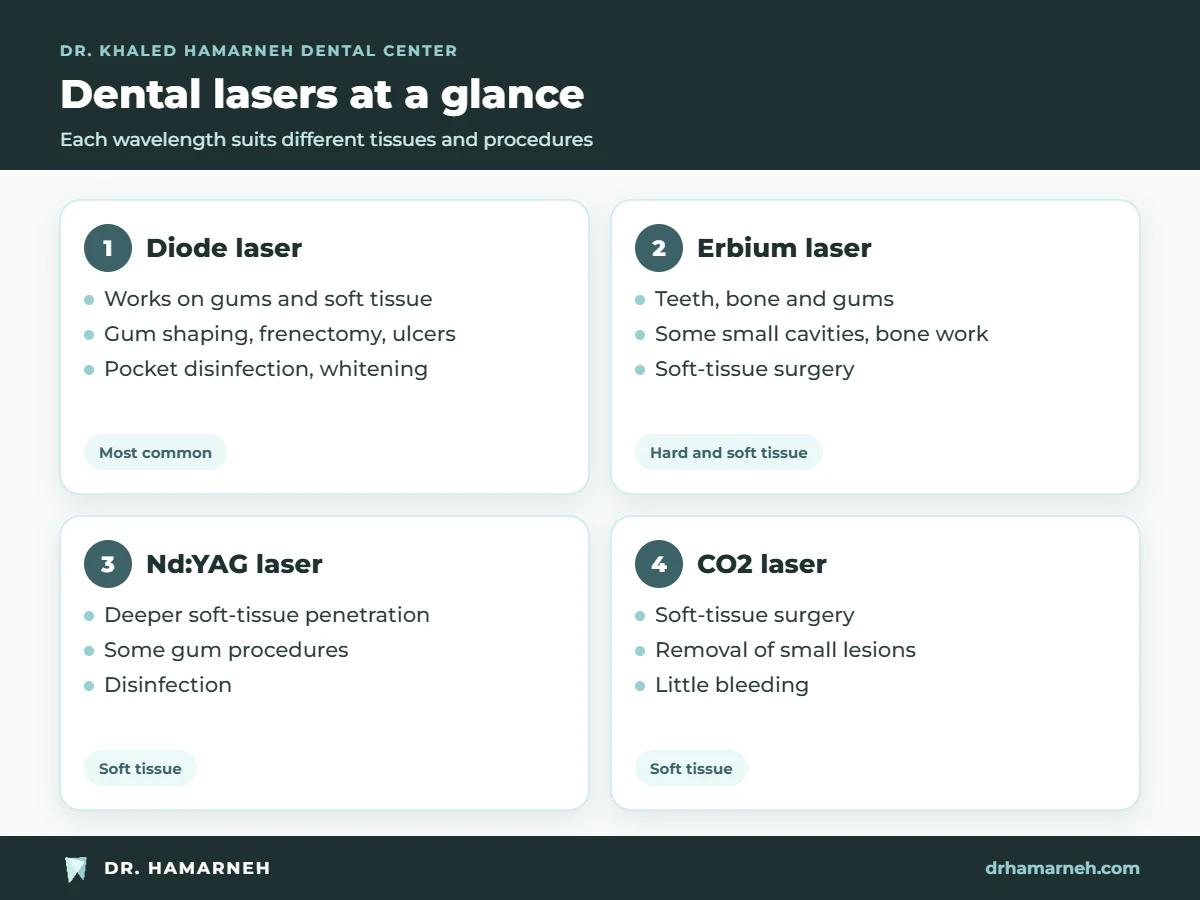
| Laser | Works mainly on | Typical uses |
|---|---|---|
| Diode laser | Soft tissue (gums) | Gum reshaping, frenectomy, ulcers, implant uncovering, pocket disinfection, whitening activation |
| Erbium laser (Er:YAG, Er,Cr:YSGG) | Hard and soft tissue | Some cavity preparation, bone procedures, soft-tissue surgery |
| Nd:YAG laser | Soft tissue, deeper penetration | Some gum procedures and disinfection |
| CO2 laser | Soft tissue | Soft-tissue surgery and lesion removal |
Diode lasers are the most common in general practice because they are compact and well suited to everyday gum procedures. Erbium lasers are larger and more expensive, and they are the type that can work on enamel and dentine.
What laser dentistry is used for
Gum contouring and gummy smiles
When gums cover too much of the teeth, or the gumline is uneven, a soft-tissue laser can reshape it precisely. Because the laser seals blood vessels as it works, there is usually little bleeding and often no need for stitches. This is common before veneers or crowns to create an even, natural frame for the new teeth.
Tongue tie and lip tie (frenectomy)
A tight band of tissue under the tongue or upper lip can affect speech, feeding in babies, or the gap between front teeth. Laser frenectomy is quick, usually involves minimal bleeding, and healing is often comfortable. Our children's dentistry team can advise whether a release is actually needed.
Mouth ulcers and cold sores
Low-power laser treatment can ease the pain of aphthous ulcers and help them settle faster for some patients.
Implants
Lasers can uncover an implant at the second stage without cutting with a scalpel, and can help decontaminate inflamed tissue around implants as part of a wider treatment plan for dental implants.
Gum pockets
Inside gum pockets, a laser can be used after thorough cleaning to reduce bacteria and inflamed tissue. The evidence here is more mixed, which we explain below.
Sensitivity and whitening
Some lasers can reduce sensitivity of exposed root surfaces, and diode lasers are used in some in-office whitening systems to activate the whitening gel.
Small cavities
Erbium lasers can remove decay in selected small cavities, sometimes without an injection. They cannot remove old metal fillings or crowns, and they are slower than a drill for larger work.
Book a consultation in Khalda. We will tell you honestly whether a laser offers a real advantage for your treatment.
The real benefits of laser dentistry
- Less bleeding. Soft-tissue lasers seal small vessels as they cut, which keeps the area clear and reduces bleeding afterwards.
- Fewer or no stitches in many gum procedures.
- Precision. The beam removes tissue in very small, controlled amounts, which matters for aesthetic gum work.
- Often more comfortable healing for soft-tissue procedures, with less swelling for many patients.
- Sometimes less anaesthetic. Some minor procedures can be done with topical numbing gel or a smaller injection.
- Disinfection. Laser energy reduces bacteria in the treated area.
Limits of laser dentistry, and common myths
- "Lasers replace the drill." Only partly. Erbium lasers can treat some cavities, but not every case, and they cannot remove metal fillings or crowns.
- "Laser treatment is always painless." Many patients need little or no anaesthetic for minor laser work, but some procedures still require it.
- "A laser cures gum disease on its own." No. Gum disease needs thorough removal of biofilm and tartar first. A laser can be an addition, not the foundation.
- "All lasers are the same." They are not. A diode laser and an erbium laser are different tools with different jobs.
- "Laser means better." Only when the procedure benefits from it. For many treatments, conventional methods work just as well.
Lasers and gum disease: what the evidence says
This is where marketing and science diverge most. The American Academy of Periodontology best evidence consensus reviewed laser use for periodontitis and peri-implant disease. Its overall message is cautious: some lasers used together with scaling and root planing may give a modest additional benefit in certain situations, but the evidence is limited and varies by laser type, and lasers should not be seen as a replacement for conventional cleaning.
In practice, that means the foundation of gum treatment is still a thorough cleaning above and below the gumline, such as guided biofilm therapy or deep cleaning, plus good home care. A laser can be useful as an extra step in selected pockets. If a clinic offers laser gum treatment instead of cleaning, ask why.
Safety, and what to expect during laser treatment
Dental lasers are safe when used by trained clinicians following safety rules. You will be given protective glasses matched to the laser's wavelength, and so will everyone in the room. During treatment you may hear a soft popping or clicking sound with erbium lasers, notice a faint smell as soft tissue is vaporised, and feel warmth rather than pain.
After soft-tissue laser procedures, the area often heals with a whitish layer for a few days, which is normal. Follow the aftercare you are given: usually soft foods for a day or two, gentle brushing around the area, and avoiding very hot or spicy food until it settles. You can read a general patient overview from Cleveland Clinic on laser dentistry.
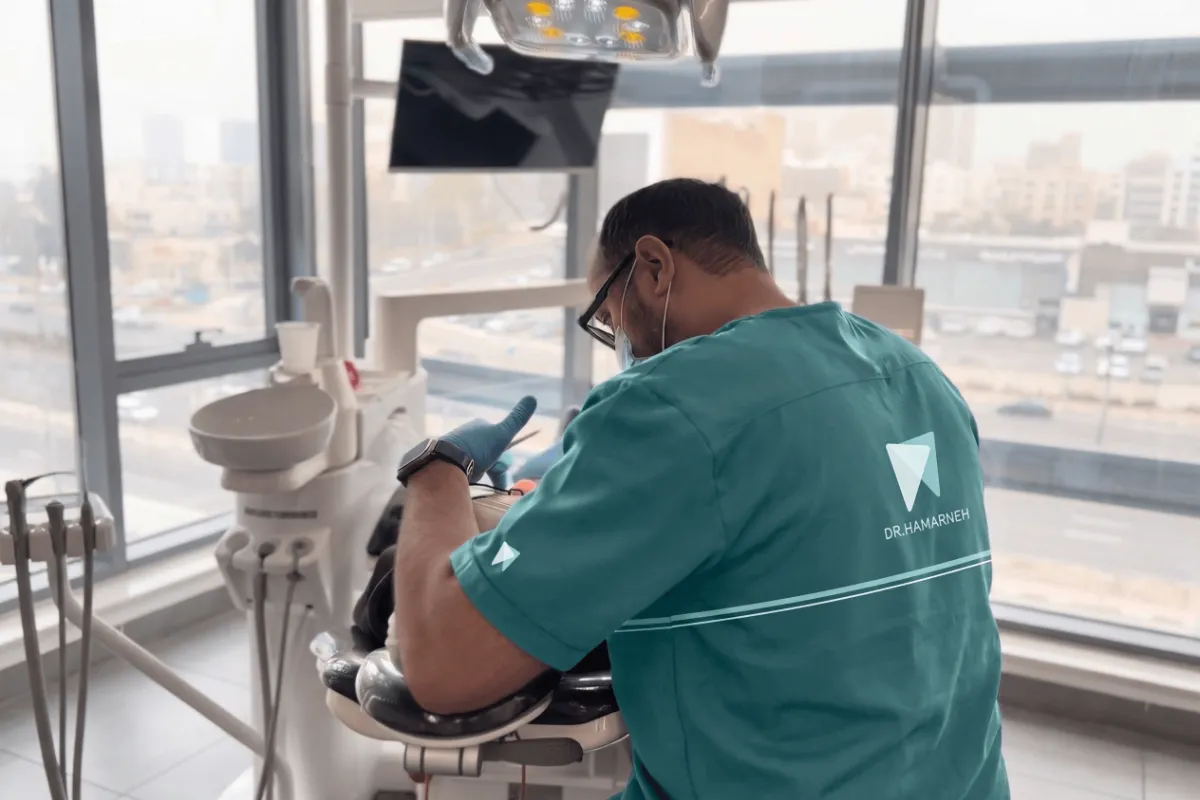
Laser dentistry at our clinic in Khalda
At Dr. Khaled Hamarneh Dental Center in Khalda, we use a laser when it gives your treatment a real advantage: cleaner gum reshaping before veneers, a quicker frenectomy with less bleeding, or extra disinfection around teeth and implants after cleaning. When a conventional method works just as well, we tell you that too.
Every laser procedure starts with an examination and a clear explanation of what will be done, what it is expected to achieve and how healing usually goes. You can read more about our team, or see our guide to 3D dental imaging for complex cases.
Minas Towers, 3rd Floor, Medical City Street, Khalda. Saturday to Thursday, 10:30 am to 7:00 pm.
Questions patients ask us
What is laser dentistry?
Laser dentistry uses a focused beam of light to cut, reshape or disinfect tissue in the mouth. Different lasers suit different tissues: diode lasers are mainly used on gums, while erbium lasers can also work on teeth and bone.
Is laser dental treatment painful?
Most patients feel warmth or slight pressure rather than pain. Many minor soft-tissue procedures need little or only topical anaesthetic, but some treatments still require a local injection for comfort.
What can a dental laser treat?
Common uses include gum contouring, gummy smile correction, tongue tie and lip tie release, mouth ulcers, uncovering implants, disinfecting gum pockets after cleaning, reducing sensitivity, activating in-office whitening and, with erbium lasers, some small cavities.
Can a laser treat gum disease without a deep cleaning?
No. Thorough removal of biofilm and tartar remains the foundation of gum disease treatment. Current evidence suggests lasers may add a modest benefit in some cases when used together with cleaning, not instead of it.
Can lasers replace the dental drill?
Only in some cases. Erbium lasers can remove decay in selected small cavities, but they cannot remove metal fillings or crowns and are not suitable for every cavity.
How long does healing take after laser gum treatment?
Minor soft-tissue procedures usually feel comfortable within a few days, and the gums typically heal within one to two weeks. A whitish layer on the treated area during the first days is normal.
Is laser dentistry safe?
Yes, when performed by a trained dentist with the correct protective eyewear for everyone in the room and the right laser settings for the procedure.
Where can I get laser dental treatment in Khalda, Amman?
Dr. Khaled Hamarneh Dental Center in Khalda uses laser dentistry for selected gum and soft-tissue procedures when it offers a clear advantage. Book online, call or WhatsApp 0791818796.